Email marketing: you can’t email people you don’t have
A guide to growing your email list for digital fundraising
In this monthly blog series, we share client and student reflections, and examples of the application of philanthropic psychology, or PhilPsych, to digital fundraising. Specifically, how PhilPsych can help fundraisers create digital communications that feel more meaningful and more respectful.
This first blog focuses on a deceptively simple truth about email marketing: You cannot email people you do not have.
That may sound obvious. But in digital fundraising, it is easy to spend most of our time thinking about what we want to send: the appeal, the newsletter, the thank-you, the campaign update, the donation ask.
Before any of that can happen, people need to have chosen to hear from us – they need to have chosen to join our email list.
If email is part of your fundraising strategy, list growth cannot be treated as an occasional activity or an administrative concern. It is, in fact, part of the relationship-building process. It is how people first raise their hand, express interest, share something of themselves, and give us permission to continue the conversation.
And because every email list shrinks over time, through unsubscribes, inactive addresses, changing preferences and natural attrition, list acquisition and retention need to be planned together. If you are not intentionally growing your email list, you are gradually losing your ability to reach, inspire and involve people who may care deeply about your cause.
So how do you continue to attract supporters to your email list so you can create beautiful communications for them? Here are five ways to bring potential donors into your email journey:
1. Mission-aligned contests
Mission-aligned contests can be useful for community building, awareness raising and bringing new people into your digital audience. They often work well when delivered in collaboration with external organizations or partners who already have access to people likely to care about your cause.
The important word here is “mission-aligned”.
A generic giveaway may increase sign-ups in the short term, but it can also attract people who are more interested in the prize than the purpose. Those people are unlikely to remain engaged after the contest ends. Worse still, you may spend money acquiring an audience that does not feel any genuine connection to your work.
A mission-aligned contest asks:
What kind of person is likely to care about this cause?
What identity, value or emotional connection might they already hold?
What would feel joyful, meaningful or relevant to them?
The possibilities for mission-aligned contests are almost endless. An animal nonprofit might invite supporters to enter a contest for their pet to feature on a special edition product. A literacy organization might offer the chance for a child’s name to appear as a character in a story. A heritage nonprofit might invite people to share a family memory connected to a place, object or tradition.
From a PhilPsych perspective, this invitation to participate matters because giving and engagement are linked to identity. People are more likely to respond when an invitation allows them to express something true about themselves, whether that is their love of animals, their pride in their community, their care for children, or their hope for a fairer future.
Mission alignment improves the quality of engagement and the likelihood of future donor conversion. In other words, it is better to attract fewer people who genuinely care than a larger list of people who never really intended to stay.
2. Value exchange
A value exchange offers something useful to the supporter while remaining clearly connected to the mission of the organization.
In direct mail, these are sometimes called mission premiums. In digital fundraising, they can work especially well when they provide practical utility, build trust, and create a natural next step into a wider supporter journey.
The key is that the item, resource, or offer should not feel like meaningless “swag”. It should help the recipient in a way that is connected to the cause.
For example, BC SPCA offered free emergency stickers for people to display in their windows, letting first responders know how many pets lived in the property and may need to be rescued in an emergency such as a fire.
That offer is practical and useful to pet owners. It is also completely aligned with the organization’s purpose: protecting animals and helping people care for them.
A similar approach for a children’s hospital might be a fridge magnet listing emergency and health-related contact numbers. It is helpful to families, connected to child health and safety, and offers a natural opportunity to learn more or donate.
These offers can cost a few dollars per new lead, but the quality of those leads is what matters. Someone requesting a pet safety sticker may already see themselves as a caring animal guardian. Someone requesting a child health resource may already be motivated by protection, family well-being, or community care.
PhilPsych helps us explore why this matters. A strong value exchange is not just a transaction in which a person gives you their email address and receives an object in return. It is an early moment of mutuality. The nonprofit offers something that supports the person’s values, and the person gives permission for a deeper relationship to begin.
3. Hand-raisers and pledges
Hand-raisers and pledges invite people to publicly or privately signal that they care about an issue.
This might include signing a petition, pledging to take an action, joining a local movement, registering interest in a campaign, or asking to receive updates about a specific topic.
These approaches can be particularly powerful because they help reveal something about a supporter’s identity. A person is not simply clicking a button. They are saying, “this matters to me.”
That’s an important distinction in PhilPsych terms.
When we invite people to stand up for something they believe in, we are creating an opportunity for them to express values, agency, and belonging. They can see themselves as part of a wider community of people who share their concern, hope or commitment.
Examples might include World Vision Ireland asking supporters to sign a petition raising concern for refugee children who have disappeared after arriving in Europe, or Greenpeace UK asking people to help end the plastic crisis.
The strongest hand-raisers do not tell people what to think or pressure them into action. They make the opportunity clear, explain why it matters, and allow supporters to choose how they wish to participate.
That sense of autonomy is important. Giving and campaigning are more fulfilling when people feel they have chosen to act in alignment with their own values. A good hand-raiser respects that autonomy while helping people take a meaningful first step.
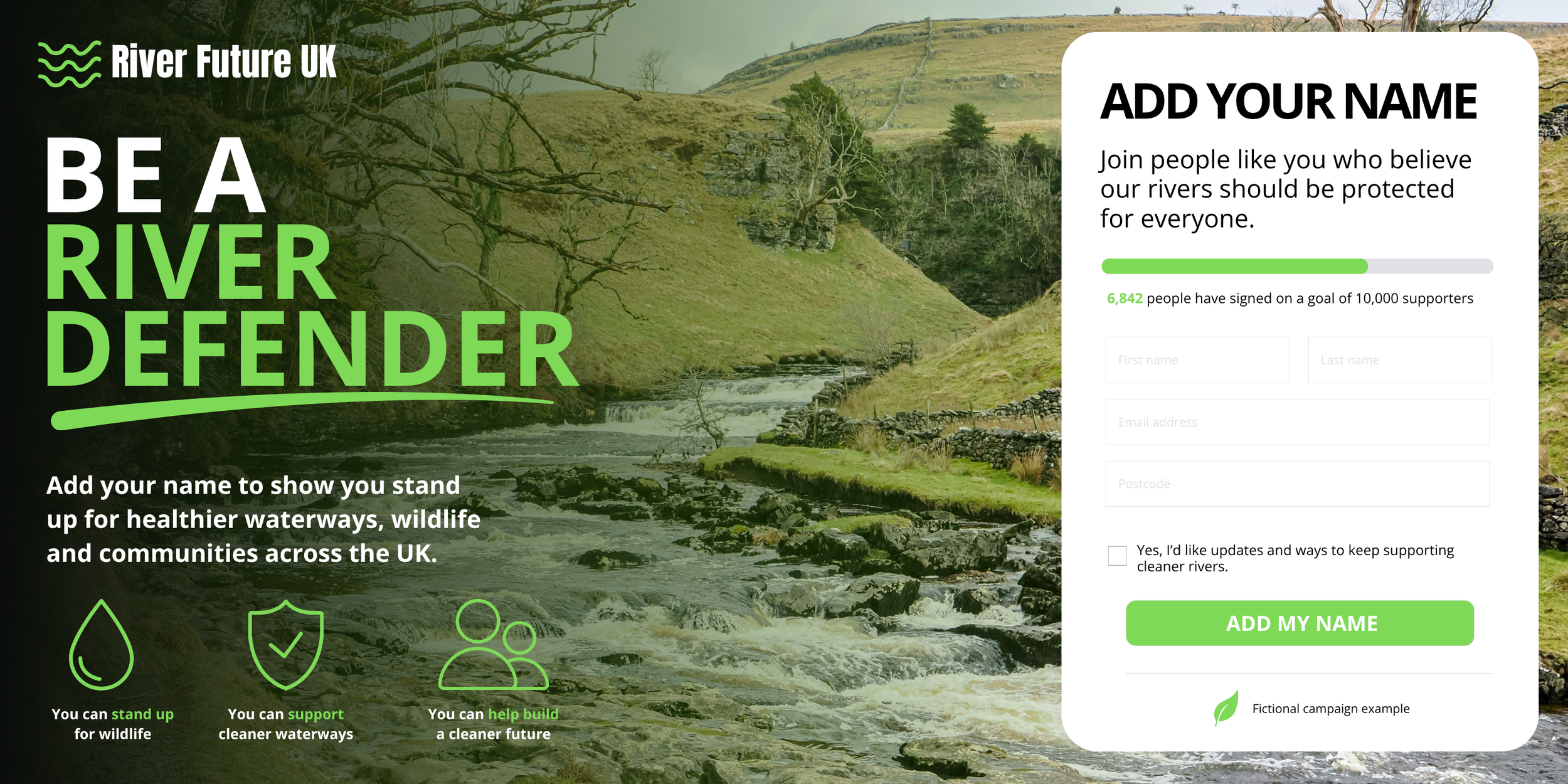
Source: Fictional campaign example created by IFSP to illustrate a PhilPsych-informed hand-raiser.
4. Direct donation asks
A direct donation ask can also be a route into your email list, particularly when you are communicating with a warm audience or reaching people at a moment of high giving intent.
This might include campaign landing pages, emergency appeals, peer-to-peer fundraising pages, social media posts, event follow-ups, or paid digital activity directed toward a specific need.
The danger is that we treat the donation as the end of the journey.
In PhilPsych terms, the gift is not simply a payment. It may be an expression of love, identity, hope, compassion, anger at injustice, gratitude, memory, or moral responsibility. If someone gives, they have told us something important about what matters to them.
That means the post-donation experience is critical.
Do they receive a thank-you that reflects who they are and what they have made possible?
Are they invited to feel connected to the change?
Do future emails build on the meaning of their first gift?
Do they feel seen as a person, rather than processed as a transaction?
A direct ask may acquire a donor, but thoughtful email stewardship is what helps that person become a continuing partner in the work.
For digital fundraisers, this means donation forms and follow-up journeys should be designed together. The first thank-you email, the welcome sequence, the next story, and the next invitation all shape whether a new donor feels fulfilled by their giving or simply asked again.
5. Retargeting ads
Retargeting ads are a more advanced way to re-engage people who have already shown interest in your organization, campaign, or content.
For example, someone may have visited a donation page but not completed their gift. They may have read a blog, watched a video, clicked on a campaign, or engaged with a social media post. Retargeting allows you to offer a relevant next step based on that previous behavior.
Used well, this can remind people of something they cared about, reduce friction, and bring them back to an action they may have intended to take.
But used poorly, it can feel intrusive and unwelcome.
The PhilPsych question is not simply, “Can we follow this person around the internet until they convert?” It is, “What would be a respectful and meaningful next invitation, given what this person has already shown us they care about?”
A retargeting ad might invite someone back to complete a donation, but it might also invite them to read a supporter story, sign up for a webinar, download a resource, or learn more about the issue. Not every next step has to be financial. Sometimes the best next step is one that deepens understanding, connection or trust.
As with all digital fundraising, consent, transparency, and data protection are essential. But beyond compliance, we should also ask whether the experience we are creating is one we would feel comfortable offering to a valued supporter in person.
What’s next?
In our next blog, we will take a deeper look at what happens when someone has joined your list, how you start to communicate with them in a way which helps them feel loved and appreciated.
Learn more
If you would like to explore how the new science of PhilPsych can strengthen your digital fundraising, you might want to consider our Certificate in Digital Fundraising.
The course is designed for fundraisers who want to move beyond digital tactics and understand how online communications can build deeper, more meaningful, and more sustainable donor relationships.
The next cohort begins in February 2027.
You are welcome to find out more about the Certificate in Digital Fundraising or speak to one of the team to consider if this course might be the right next step for your practice.