
The success that follows in Philanthropy
On 4 June 2026, Sarah Colberg, Interim Head of Corporate Partnerships, Catherine Day, Head of Philanthropy at RSPCA UK, and Dr. Jen Shang presented at the CIOF Annual conference in a session titled “At the Heart of Giving: How You Can Foster Meaningful Donor Relationships with Philanthropic Psychology.”
Across this four-part blog series, we’ll uncover how Catherine and Sarah have guided their teams on a PhilPsych journey: discovering what it truly means to understand their donors. They applied philanthropic psychology to bridge communication gaps between mass donors and those at the corporate or high-value level, and follow practical steps that any fundraiser, even a team of one, can implement to deepen relationships and inspire love and giving.
Blog 3: The success that follows in Philanthropy
Blog 4: You can do it even with a one-person fundraising team
In the first blog of this series, we revealed a powerful insight discovered by Catherine and Sarah: wealthy donors care deeply about animal welfare, but they also want their support to create meaningful change in society. This belief is not theirs alone; it’s shared also by many of their corporate partners.
If you missed the early lessons that laid the foundation for their later successes, we strongly recommend starting with their journey’s beginning. Understanding where they started not only makes their roadmap clearer, it makes your own path to success far clearer.
In the second blog, we celebrated the story of their corporate partnerships: how the team inspired companies to express their love for animals and, in doing so, reenergised their own purpose and passion.
In this next blog, we turn to their philanthropic success: moments created by consciously taking every opportunity to:
Deepen the connection
Harness shared values
Shift the spotlight
Here, we’ll explore how RSPCA UK put these principles into practice.
In the final blog of this four-part series, we’ll show how even a one-person fundraising team can make these same changes with transformational results.
Deepen the connection
When Oli, the new centre manager, sent handwritten notes to event participants, his words were simple yet full of heart. Each line radiated warmth and genuine excitement: he mentioned you six times in a short message! That repetition wasn’t a coincidence; it showed care, attention, and a real desire to connect.
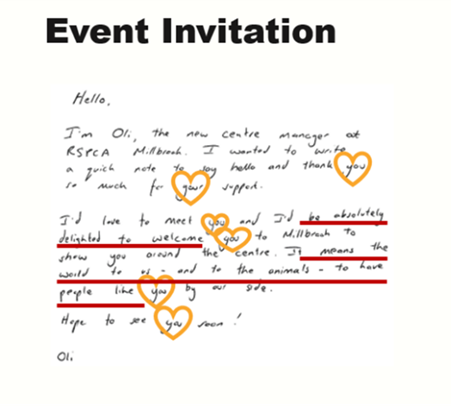
He didn’t just say he was “delighted” to meet them: he was absolutely delighted to welcome them. Before guests even visited, he was already thanking them for being “by our side” and letting them know they meant “the world to us and to the animals.”
That authenticity didn’t end on paper. When donors arrived, they met an Oli whose warmth and enthusiasm exceeded the promise of his note. His connection was real, natural, and heartfelt: he wrote not because he was told to, but because that’s how he genuinely wanted to relate to his donors.
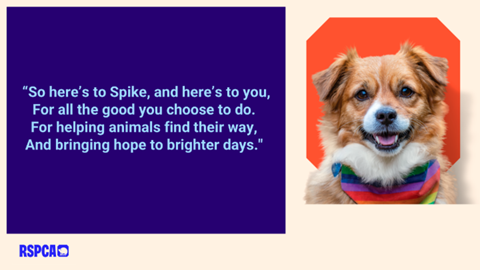
The same spirit is embodied by Dan Desiano-Plummer, Senior Philanthropy Manager at RSPCA UK, who spent an afternoon writing a poem for a donor who had lost her beloved dog, Spike. Her £500 gift, made in his memory, inspired Dan to write a tribute “from all of us—to you, to Spike, and to the love and legacy you continue to carry forward in his name.” It was a small gesture with an enormous emotional impact.
Harness shared values
Connection grows even deeper when we celebrate who our donors are, alongside of their beloved animals. One of RSPCA UK’s fundraising events began with a simple insight from donor research: women are passionate about animal welfare.
The charity had recently received a record-breaking £180 million legacy gift, its largest ever, from the late Katherine Martin. She is an inspirational woman whose values are shaping the future. The team used her gift as a catalyst to bring together women who “share a passion for animals, people, and the planet,” harnessing their collective power to create lasting change for animals and society alike.

Did you notice how in this invitation, what is being celebrated, is not a little abused or neglected animal waiting for rescue or even the RSPCA officers who rescue them anymore, but the women who care about these animals and wanting to create a better world for them all.
Shifting the spotlight
At first glance, these stories might seem to shift the spotlight entirely to donors. But have they really? Let’s look closer.
Oli welcomed supporters into RSPCA’s new centre, letting them experience its warmth and community firsthand. Dan placed the donor, and her love for Spike, at the centre of his poem, showing how RSPCA staff share the same compassion. And the event celebrating women recognises their power, values, and commitment, all aligned with the charity’s mission.
By placing donors in the spotlight, we’re not pushing the charity, or the animals, into the background. We’re illuminating a shared vision, one where love for animals connects deeply with the donor’s sense of self. Through sincere appreciation, heartfelt celebration, and creative gestures of love, this connection thrives.
When applied thoughtfully, PhilPsych isn’t about heroes or saving battles. It’s about love coming vividly to life between people who care.
If you missed the earlier blogs in this series, you can read:
Blog 1: Getting to know your donors, truly – where RSPCA set out the foundations that their success is built upon
Blog 2: The successes that follow in Corporate Partnership – sharing how they build genuine, strong relationships with corporate partners
Blog 4: You can do it even with a one-person fundraising team, is also now available.
If you would like to start your own PhilPsych journey, you might want to explore our Certificate in Philanthropic Psychology course. The next cohort starts September 2026.